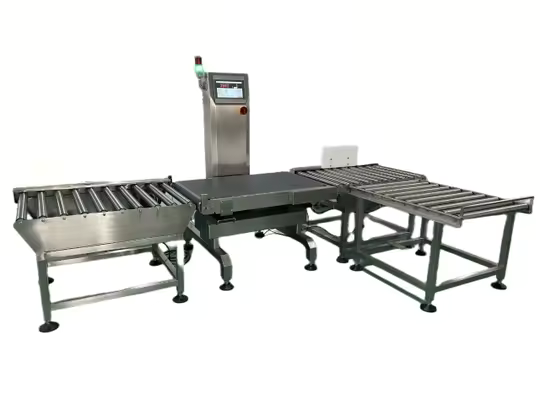
Automatic Checkweigher vs Manual Weight Checking: Which Is Better for Modern Production Lines?
Weight control is essential in modern packaging and processing operations. Whether you produce food, pharmaceuticals, logistics parcels, or industrial packaged goods, consistent product weight affects quality, compliance, customer satisfaction, and cost control.
Many manufacturers still rely on manual spot checks, while others adopt an automatic checkweigher for continuous inline inspection. But which approach is better for modern production lines? In this article, we compare automatic checkweighing and manual weight checking in terms of efficiency, accuracy, labor cost, and long-term value.
1. What Is Manual Weight Checking?
Manual weight checking usually means that operators remove products from the line, place them on a scale, record the results, and decide whether the products are within the acceptable weight range.
This method is still used in some small production environments because it appears simple and has a lower initial equipment cost. However, manual checking often depends heavily on operator consistency and only samples a limited number of products.
2. What Is an Automatic Checkweigher?
An automatic checkweigher is a conveyor-based system that weighs products during production and automatically rejects items that are underweight or overweight. It performs continuous inline inspection without stopping the production flow.
Modern checkweighers can also integrate with reject devices, production data systems, and even combined inspection solutions such as an automatic checkweigher with metal detector.
3. Accuracy and Consistency
One of the biggest differences between the two methods is consistency. Manual weighing depends on human handling, reading, and recording. Even when operators are careful, results may vary due to fatigue, speed pressure, or inconsistent sampling methods.
An automatic checkweigher offers much better repeatability because it uses a controlled weighing process for every product that passes through the line. This helps manufacturers:
- Reduce underweight risk
- Control overweight giveaway
- Improve quality consistency
- Create more reliable inspection records
For production lines that require stable quality control, automation provides a major advantage.
4. Speed and Production Efficiency
Manual weight checking is slow by nature. Operators must stop, remove, inspect, and sometimes record products individually. This makes manual inspection unsuitable for fast or continuous packaging lines.
By contrast, an automatic checkweigher can inspect products continuously at line speed. For manufacturers running medium- to high-volume operations, this means:
- Faster inspection throughput
- Less interruption to production
- Higher overall line efficiency
- Better support for continuous operation
If you operate a high-output packaging line, a high-speed checkweigher is far more practical than manual inspection.
5. Labor Cost and Operational Burden
Manual inspection may seem cost-effective at first because the equipment investment is low. However, the long-term labor burden is much higher. Operators must spend time inspecting products, recording data, and separating non-conforming items.
As production volume increases, manual checking becomes more expensive because it requires more labor and creates a higher risk of human error.
An automatic checkweigher reduces manual intervention by handling inspection and rejection automatically. This helps manufacturers lower labor dependency and use staff more efficiently in other parts of production.
6. Sampling vs 100% Inspection
Manual weight checking is usually based on sampling. Only selected products are weighed, which means some underweight or overweight items may pass through without being detected.
An automatic checkweigher provides near 100% inline inspection, depending on the production setup. This gives manufacturers much stronger process control and a better chance of detecting problems in real time.
For businesses that want tighter quality assurance, automatic inspection is the more reliable solution.
7. Data Collection and Traceability
Modern production lines increasingly require traceable inspection records. Manual checking often relies on handwritten notes or spreadsheet entries, which may be incomplete or inconsistent.
Automatic checkweighers can support digital data collection, production monitoring, and system integration. This allows manufacturers to:
- Track weight performance over time
- Identify process deviations earlier
- Support internal quality audits
- Improve production reporting
This is especially valuable in regulated industries and quality-focused manufacturing environments.
8. Product Giveaway and Cost Control
Overfilling products to avoid underweight risk is a common hidden cost in production. Manual checking makes it harder to control giveaway precisely because the process is slower and less consistent.
An automatic checkweigher helps manufacturers maintain tighter weight control, which can reduce unnecessary product giveaway and improve profitability over time. For high-volume production, even a small reduction in overweight filling can create significant savings.
9. When Manual Checking May Still Be Acceptable
Manual weight checking may still be suitable in certain situations, such as:
- Very low production volume
- Startup operations with limited automation
- Temporary or non-continuous packaging activity
- Applications where only basic sampling is required
However, once output increases or quality requirements become stricter, manual inspection usually becomes inefficient and difficult to manage.
10. When an Automatic Checkweigher Is the Better Choice
An automatic checkweigher is generally the better choice when you need:
- Continuous inline inspection
- High production efficiency
- Better weighing consistency
- Lower labor dependency
- Better traceability and data control
- Improved long-term return on investment
If your production line has special application requirements, you may also consider a custom OEM checkweigher solution tailored to your product, layout, and throughput needs.
Conclusion
Manual weight checking can work for small-scale or low-speed operations, but it has clear limitations in speed, consistency, labor cost, and traceability. For modern production environments, an automatic checkweigher provides a more efficient and reliable solution.
It supports inline inspection, reduces human error, improves weight control, and helps manufacturers maintain stable packaging quality. As production demands increase, the benefits of automatic inspection become even more obvious.
If you are comparing solutions for your packaging line, contact us for technical advice, or review our checkweigher models and specifications to find the right system for your application.
Frequently Asked Questions
Is an automatic checkweigher more accurate than manual checking?
In most production environments, yes. An automatic checkweigher offers more stable repeatability and reduces the risk of human error.
Why is manual weight checking less efficient?
Manual checking requires operators to stop, inspect, and record products individually, which slows production and increases labor dependency.
Can an automatic checkweigher inspect every product?
Yes. Automatic checkweighers are designed for continuous inline inspection and can check products at production speed.
When should a manufacturer upgrade from manual checking?
Manufacturers should consider upgrading when production volume increases, quality requirements become stricter, or labor efficiency becomes a concern.